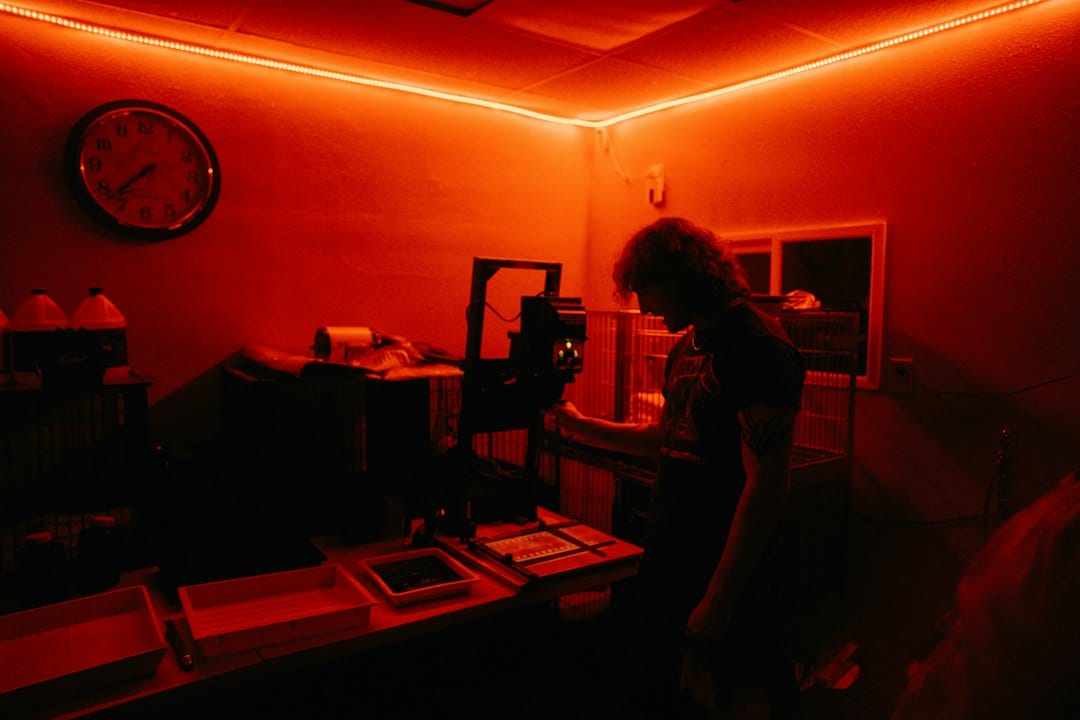
It’s almost here.
After months of planning, building, sourcing equipment, and setting up the space, The Saint Paul Darkroom opens November 1st at 970 Raymond Avenue in Saint Paul.
I’ve been talking about this for a while now — what a darkroom is, what happens inside one, why I chose to build this instead of upgrading my digital gear. If you’ve been following along, you know the ‘why’ behind this project.
This post is about the specifics. What the space offers. What your first session actually looks like. And how to make sure you’re not locked out when we open.
What The Saint Paul Darkroom Is
The Saint Paul Darkroom is a shared darkroom facility inside my studio space at 970 Raymond Avenue, Suite G10, in Saint Paul. It’s designed for photographers who want to work with film and analog processes in a properly equipped space — without having to build their own darkroom at home.
The space is set up for:
Film development
Bring your exposed rolls of 35mm or medium format film. We’ll develop them together — loading the developing reel in the changing bag, processing through developer, stop bath, and fixer, and opening the tank to see your negatives for the first time. If you’ve shot film and sent it off to a lab for development, doing it yourself is a different experience. You’re part of the process in a way that changes how you understand it.
Print making
Once you have negatives — from a roll we developed together, or ones you’ve brought in from previous shoots — we move to the enlarger. You’ll select a frame, dial in your focus and exposure, expose the paper, and watch your print appear in the developer tray. This is the part most people describe as the moment they understood why people do this.
Open studio access
For photographers who have darkroom experience and want access to the space and equipment, open studio sessions are available. These are less structured — you know what you’re doing, you have your own film and paper, and you need a well-equipped space to work in. That’s what open studio is for.
Who This Is For
I want to be specific about this, because ‘who is this for’ is the question that determines whether you’ll get something meaningful out of your first session.
The Saint Paul Darkroom is for you if:
You’ve been shooting film and you want to learn what happens to it after it leaves your camera. You understand the shooting side of film photography and you’re curious about development and printing.
You learned darkroom technique somewhere at some point and haven’t had a space to practice. Maybe it was in school. Maybe it was in another city. Either way, the skills are there and you just need access.
You’re new to all of it — you’ve been hearing about the film photography revival and you want to try it in a hands-on way, not just by watching videos. First-timers are completely welcome. Every session is calibrated to where you actually are.
You’re a photographer who’s been shooting digitally and you want to understand what film offers — not to replace your digital practice, but to expand it. A lot of working photographers come to darkroom work for the same reason I did: to slow down and think differently about light and image-making.
What Your First Session Looks Like
Before you arrive, I’ll ask what you’re bringing and what you’re hoping to do. That shapes the session structure.
If you’re coming with exposed film to develop, we’ll start there. Loading the reel, running through the chemistry, washing and drying your negatives. Then we move to the enlarger and make at least one print from your negatives.
If you’re coming without film — because you want to try printing before you commit to shooting film, or because you want to start with the print-making experience — we can work with negatives I provide so you still have something hands-on to work with from the start.
Sessions run two to three hours, depending on what we’re doing. The space accommodates a small number of participants — intentionally. I’m not running a large group class where you take turns and wait. Everyone who books a session gets real time with the equipment and real attention throughout the process.
What to Bring
Exposed film, if you have it. 35mm or medium format — both formats are supported.
Negatives, if you want to work on printing without developing. Any format we can accommodate in the enlargers.
Clothes you don’t mind getting chemistry on. Darkroom chemicals won’t ruin clothing the way paint might, but they can cause minor staining and they have a distinct smell. Dress practically.
Curiosity. The process is unfamiliar. Things will go differently than you expect — sometimes better, sometimes not. That’s the nature of it, and it’s actually part of what makes darkroom work interesting.
Nothing else is required. Chemistry, paper, equipment — all of it is provided.
How to Get In First
First sessions will fill from the waitlist. I’ll reach out to people on the list before November 1st with session availability, pricing, and booking details — before any of that goes live to the public.
If you’ve been thinking about adding your name but haven’t yet, now is the moment. The waitlist link is below, and it takes about thirty seconds to fill out.
If you have questions you want answered before you add your name — about what formats we support, what experience level is appropriate, what the pricing structure looks like — reach out directly. I’d rather you ask and get a real answer than either sign up for something that’s not right for you or miss out because you weren’t sure.
November 1st is three days away. The waitlist is open now.