I’ve been hearing the same thing from photographers across the Twin Cities for the past year.
They picked up a film camera. Maybe it was sitting in their parents’ closet. Maybe they found one at an estate sale for fifteen dollars. Maybe a friend handed them one at a concert and said ‘try this.’
And something changed. Not because the photos were sharper. Not because the workflow was easier. In fact, everything about film is slower and more uncertain — and that’s exactly the point.
What a Darkroom Actually Is
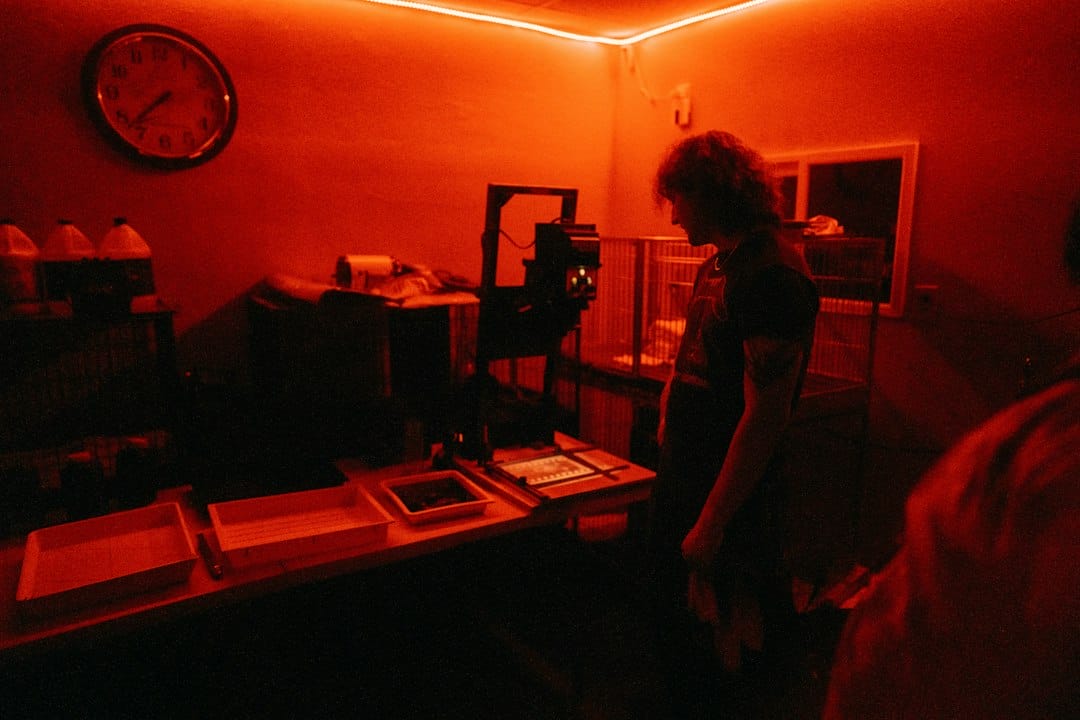
A darkroom is exactly what it sounds like: a room where light is controlled, usually to near-total darkness, so that photographic paper and film can be developed without being exposed and ruined. But ‘a dark room’ sells it short. A real darkroom is a chemical workspace — a place where you take the latent image captured on film and bring it into physical existence through a series of chemical baths.
The enlarger
This is the centerpiece of the print-making side of darkroom work. An enlarger is essentially a projector that shines light through your negative and projects that image onto photographic paper below. You can adjust the size, focus, and exposure time to control exactly how your final print looks.
The chemical trays
On the wet side of the darkroom, you’ll find a series of trays — typically developer, stop bath, and fixer — where the paper or film moves through a sequence of chemical reactions that make the image permanent. Watching an image appear in the developer tray for the first time is genuinely one of the most magical experiences in photography.
The safelight
Most darkrooms use a dim amber or red safelight that lets you see what you’re doing without exposing your photographic paper. Film development happens in complete darkness or inside a light-tight tank — no safelight there.
Why Film Is Having Such a Serious Moment Right Now
Film photography never fully went away. But what’s happening right now is different — a genuine influx of new and returning shooters, and the Twin Cities creative scene is no exception.
Everything digital is infinite — and that’s exhausting
Film has a finite number of frames per roll — usually 24 or 36. That scarcity changes everything about how you shoot. You slow down. You look more carefully. You make a deliberate choice before you press the shutter. That friction is the feature, not the bug.
The aesthetic isn’t replicable
Film grain, color rendering, tonal transitions, the slight vignetting of older lenses — these things have been endlessly studied and imitated in Lightroom presets and Instagram filters, and they always fall a little flat. The real thing has a quality that’s genuinely difficult to reproduce digitally.
What’s Coming to Saint Paul
The Saint Paul Darkroom opens November 1st — a dedicated community darkroom and film photography learning space right here in the Twin Cities. If you’ve been curious about film or want to get back into the darkroom, this is your on-ramp. More details coming soon.