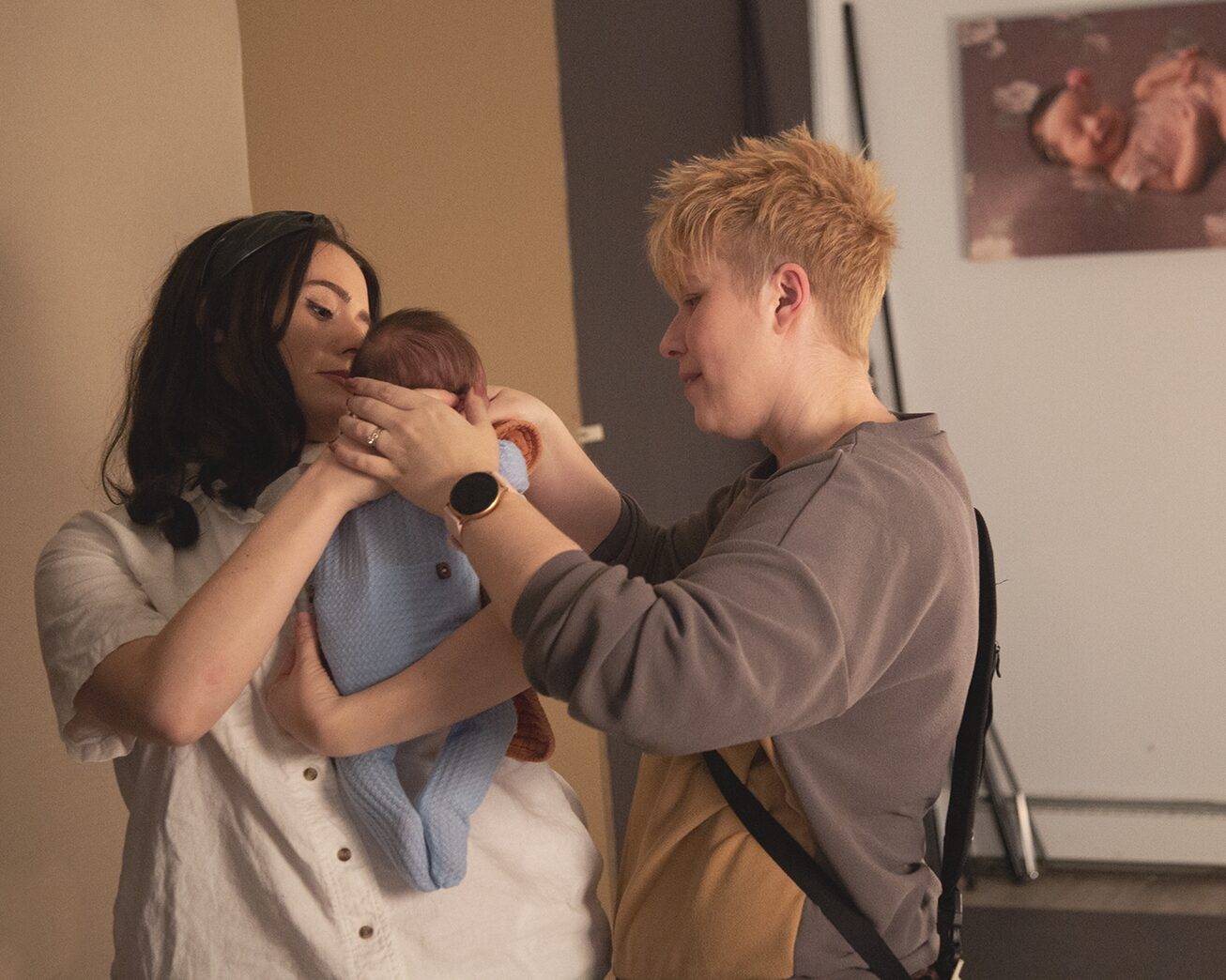
If you are thinking about adding newborn photography to your work — or if you are already shooting newborns and know that something in your practice needs real attention — you have probably started looking at mentoring options. There are a lot of them. Workshops, intensives, online courses, shoot-alongs, group sessions, one-on-one programs. The range of formats, prices, and promises can feel overwhelming before you have even made a single inquiry.
I have been photographing newborns for over twenty-five years. I have also been educating photographers for a long time, and I have watched what happens when photographers skip proper training, rush through it, or choose the wrong mentor for where they are. I have seen the difference it makes — in the quality of the work, in the confidence of the photographer, and most importantly in the safety of the babies in their care.
This post is not a sales pitch. It is a genuine guide to what actually matters when you are evaluating newborn photography mentoring — the questions to ask, the red flags to watch for, and the things that separate training that changes your practice from training that just fills a weekend.
Why Mentoring Matters More in Newborn Photography Than Almost Any Other Genre
Let me be direct about something that does not get said enough: newborn photography is one of the highest-stakes genres in portrait photography.
You are working with subjects who cannot tell you they are uncomfortable. Who cannot move themselves out of a position that is hurting them. Who are entirely dependent on the adults in the room to keep them safe. The margin for error is smaller than in almost any other kind of photography, and the consequences of getting it wrong are not just bad images — they are injury to a baby who trusted you.
This is not meant to frighten you away from the work. It is meant to underscore why training matters here in a way that it simply does not matter as much in landscape photography or senior portraits or brand work. In those genres, inadequate training produces mediocre images. In newborn photography, inadequate training can produce something far worse.
That is why the question of who you learn from and how you learn matters so much.
What to Actually Look for in a Newborn Photography Mentor
1. Real, Extensive Experience With Newborns Specifically
This sounds obvious but it is worth saying clearly: your mentor should specialize in newborn photography, not just include it as one of many things they shoot. There is a significant difference between a photographer who has done a few newborn sessions and one who has spent years working exclusively or primarily with newborns.
Ask how many newborn sessions they have photographed. Ask how long they have been specializing in this work. Ask whether newborns are a central part of their practice or a side offering. The answers will tell you a great deal about the depth of knowledge they are bringing into the room with you.
Experience also means having encountered problems and knowing how to solve them. A photographer who has shot fifty newborn sessions has seen far less than one who has shot five hundred. You want someone who has worked with fussy babies, complicated families, unexpected situations, and difficult poses — and who can teach you how to navigate all of it because they have actually been there.
2. A Clear and Serious Approach to Safety
Safety should not be a bullet point on a mentor’s website. It should be woven into everything they teach, everything they demonstrate, and every decision they make during a session.
When you evaluate a potential mentor ask them directly: how do you approach safety in your sessions? What composite poses do you use and why? How do you handle a baby who is resisting a pose? What is your protocol when something doesn’t feel right?
A mentor who takes safety seriously will have detailed, thoughtful answers to these questions. They will be able to explain not just what they do but why. They will have clear non-negotiables. They will be the kind of person who stops a pose rather than pushes through it.
If a mentor is vague about safety, dismissive of your questions, or seems to treat it as a formality rather than a foundation — keep looking.
3. Hands-On, In-Person Training
There is a place for online education in photography. But for newborn photography specifically — where so much of what you need to learn is tactile, spatial, and situational — there is no substitute for being in the room.
You need to see how an experienced photographer’s hands move when they are transitioning a baby between poses. You need to feel the difference between a position that is secure and one that is not. You need to watch how a skilled photographer reads a baby’s cues in real time and adjusts accordingly. You need to observe how they manage parents, keep the energy in the room calm, and make decisions on the fly when a session is not going as planned.
None of that translates fully through a screen. In-person, hands-on mentoring is the gold standard for this work and it is worth seeking out even if it requires travel or a larger investment.
4. A Live Newborn Component
Posing dolls are a valuable teaching tool. They allow you to practice handling and positioning without the pressure of a real baby, and a good mentor will use them to build your foundational technique before moving to live work.
But at some point in your training you need to be in the room with a real baby. The difference between a doll and a newborn is significant — in weight, in movement, in unpredictability, in the way a baby’s body responds to being held and positioned. A mentor who offers only doll work is giving you an incomplete education.
Look for mentoring that includes both — doll work for building technique and a live session component for applying what you have learned in a real environment. Observation of a live session, even without hands-on posing, teaches you things that no doll practice can replicate.
5. Small or One-on-One Format
Group workshops can be valuable at certain stages of your development. But for foundational newborn training, the smaller the better.
In a large group workshop you are competing for proximity to the baby, for the mentor’s attention, for the chance to ask your specific question at the moment it matters. In a one-on-one setting every moment of the day is tailored to where you are and what you need. The mentor can slow down when something isn’t clicking, go deeper when you are ready for it, and address the specific gaps in your practice rather than teaching to the average of a room full of people.
If your budget allows for it, one-on-one mentoring is almost always worth the premium over a group format for this kind of foundational work.
6. Clear Takeaways and Post-Intensive Support
A single day of intensive learning is a lot to absorb. The best mentoring programs acknowledge this and build in support for after the day is over.
Look for mentors who provide printed or digital resource materials you can reference back in your own studio. Look for some form of follow-up support — whether that is email access for a defined period, a follow-up call, or access to a community of other photographers going through similar work.
The goal of mentoring is not just to give you a great day. It is to change how you work going forward. Support after the intensive is what bridges the gap between what you learned in the studio and what you actually do in your own sessions.
7. A Mentor Whose Work You Genuinely Admire
This one is simple but important. Look at the mentor’s portfolio. Really look at it. Do their images reflect the kind of work you want to make? Do you admire their posing aesthetic, their lighting, their editing, the way they capture the relationship between baby and family?
You are going to absorb a lot from whoever you spend a full day learning from. Make sure what you are absorbing is genuinely aligned with the kind of photographer you want to become.
Red Flags to Watch For
A few things worth paying attention to as you evaluate mentoring options:
No clear safety framework. If safety is not prominently and specifically addressed in how a mentor describes their training, that is a significant concern.
Vague or inflated promises. Mentoring can transform your practice. It cannot guarantee you bookings, income, or business success. Be skeptical of anyone who promises specific outcomes.
No application or screening process. The best mentors are selective about who they work with because they are investing real time and attention in each person. A mentor who will take anyone who pays is not necessarily giving you the individualized experience that makes mentoring worth the investment.
No live baby component. As discussed above — doll work alone is not sufficient training for real newborn sessions.
Price that seems too good to be true. Quality mentoring costs money because it requires significant time, expertise, and resources from the mentor. Extremely low-priced mentoring often reflects a corresponding lack of depth, experience, or structure.
The Safety Section — Because It Cannot Be Said Enough
I want to come back to safety one more time because I think it deserves its own space in this conversation.
The newborn photography industry has grown enormously over the past two decades. With that growth has come an influx of photographers entering the newborn space without adequate training — drawn by the beauty of the work and the demand from families, but without a full understanding of what safe newborn posing actually requires.
Babies have been injured during newborn photography sessions. Not because photographers did not care — most of them cared deeply. But because they did not know what they did not know. Because they had learned from watching Instagram videos rather than from someone who could correct their technique in real time. Because they pushed through a pose that was not working rather than stopping and reassessing.
Proper training does not just make you a better photographer. It makes you a photographer that parents can genuinely trust with the most vulnerable person in their family. That trust is the foundation of everything else — your reputation, your referrals, your longevity in this work.
When you invest in real mentoring from someone who takes safety seriously, you are not just investing in your business. You are investing in every baby who will ever be in your care.
A Note About My Own Mentoring Intensive
If you are a photographer who is serious about doing this work right — whether you are just starting out or you know your current practice needs real attention — I would love to talk with you about the Newborn Photography Mentoring Intensive I offer here in Saint Paul.
It is a full day, one-on-one in my studio. We work through safe posing and handling using a professional posing doll, you observe and photograph a complete live newborn session, and you leave with printed resource materials, 30 days of email support, and a follow-up call. The investment is $1,200 and spots are limited because I take on very few mentees each year.
If what I have described in this post sounds like the kind of training you have been looking for, I invite you to apply. You can find all the details and the application on my mentoring page.
I look forward to hearing from you.