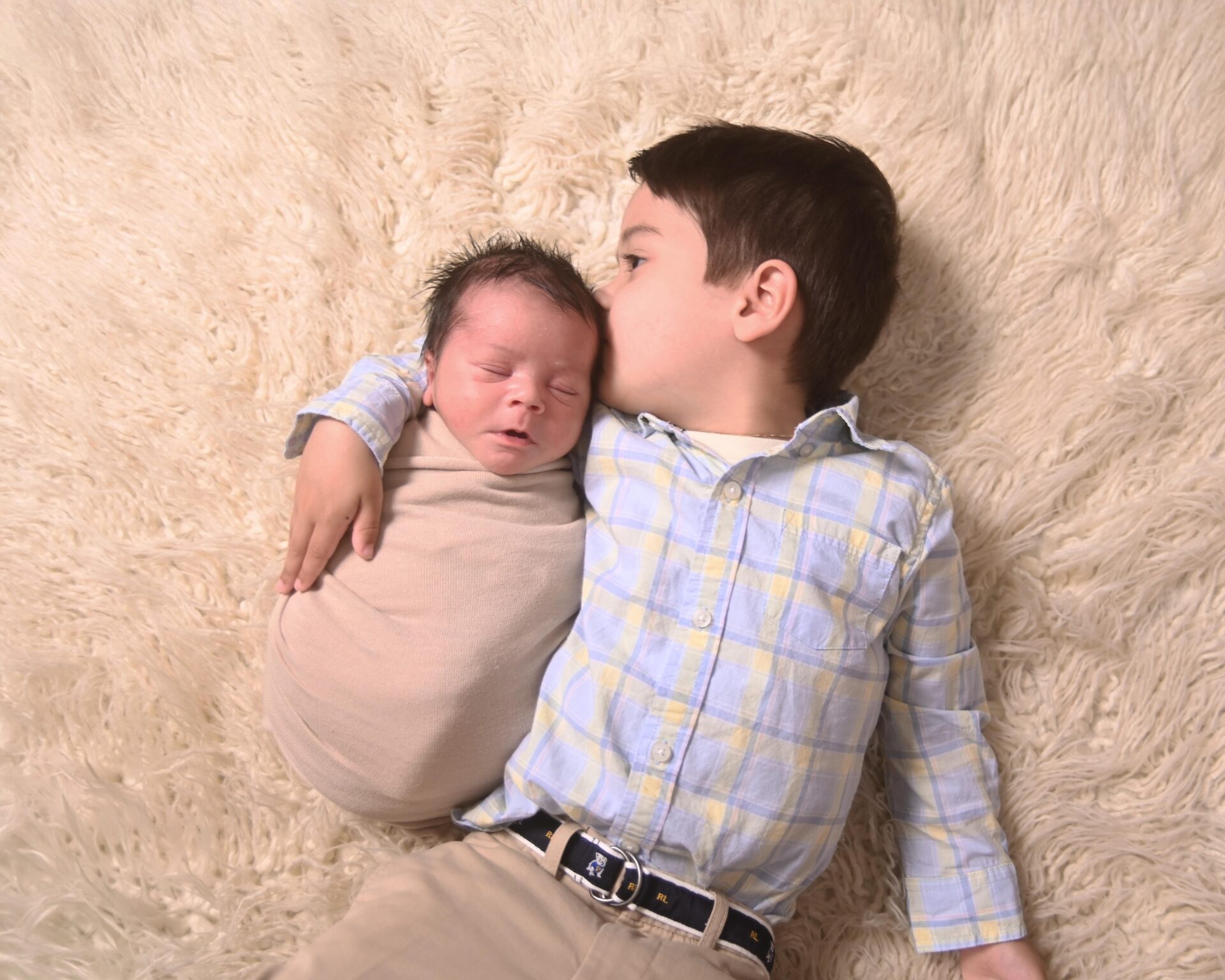
Including siblings in newborn photos is one of the most meaningful parts of a session.
It’s also one of the biggest sources of anxiety for parents.
Will my toddler sit still?
What if they squeeze too hard?
What if they get jealous?
What if they refuse entirely?
These are real concerns.
Newborns are tiny.
Toddlers are unpredictable.
And emotions run high in those first few weeks.
So when families ask how sibling photos are handled safely, the answer isn’t “carefully” in a vague sense.
It’s methodically.
Gently.
Intentionally.
Without pressure.
Safety Is the Foundation
Before we ever talk about expressions or composition, we talk about safety.
Newborns cannot support themselves.
They rely entirely on adults to:
-
Protect their head and neck.
-
Prevent falls.
-
Avoid airway compression.
-
Monitor circulation.
-
Recognize stress cues.
When siblings are involved, the responsibility doubles.
Which means the approach must be steady and structured.
The Baby Is Always Physically Supported
This is the non-negotiable rule.
Newborns are never placed in positions where a sibling is solely responsible for holding them upright.
Even when it appears that a toddler is “holding” the baby, there is always hidden support:
-
A parent’s hand just out of frame.
-
The baby positioned securely on a stable surface.
-
Composite editing if needed.
-
The newborn anchored in a safe pose first.
Safety is invisible in the final image.
But it is constant during the session.
Toddlers Are Not Expected to Be Careful
One of the biggest mistakes in sibling sessions is expecting toddlers to behave like adults.
They are excited.
They are curious.
They are still learning boundaries.
Instead of saying:
“Be careful.”
We give simple, concrete instructions.
“Put your hands right here.”
“Lean your cheek gently.”
“Let’s sit criss-cross.”
Clear physical guidance reduces uncertainty.
And reducing uncertainty reduces impulsive movement.
Sessions Are Structured in Short Windows
Siblings—especially toddlers—have limited attention spans.
Rather than forcing extended posing, sibling moments are approached in short, focused windows.
-
A few minutes of structured interaction.
-
Then a break.
-
Then a reset if needed.
This prevents frustration from building.
And it protects the baby from unnecessary handling.
Reading Body Language Matters
Sibling sessions require careful observation.
If a toddler:
-
Starts bouncing.
-
Tightens their grip.
-
Looks overstimulated.
-
Avoids eye contact.
-
Becomes overly excited.
We pivot.
Immediately.
There is no pushing through for “just one more.”
Photos are never worth stress.
Calm Environment Helps Siblings Too
The environment influences siblings just as much as it influences newborns.
A quiet studio.
Low noise.
No chaotic movement.
Soft guidance.
Children mirror the tone of the room.
If the session feels rushed, siblings feel it.
If it feels steady, they settle more easily.
There Is No Forced Affection
Not every sibling wants to cuddle immediately.
And that’s okay.
Sometimes the most meaningful sibling images come from:
-
A curious glance.
-
A tentative touch.
-
A small lean-in.
-
A proud expression.
We never force hugs.
We never demand kisses.
Authenticity matters more than performance.
The Baby’s Comfort Comes First
If at any point the newborn shows signs of stress:
-
Flushed skin.
-
Startle reflex.
-
Fussing.
-
Overextension.
We stop.
Sibling photos are secondary to newborn regulation.
There is always another angle.
Another approach.
Another way to document connection safely.
Composite Images When Needed
Some sibling poses you see online are not captured in a single frame.
They are composites.
This means:
-
The baby is photographed safely and separately.
-
The sibling is photographed in a controlled position.
-
The images are combined later.
Composite techniques allow creative sibling portraits without compromising safety.
Parents often don’t realize how much editing supports secure posing.
But safety always comes first.
Preparing Siblings Before the Session
Parents often ask if they should “coach” their older child beforehand.
Simple preparation helps:
-
Talk about the baby being small and fragile.
-
Explain that the photographer will help.
-
Avoid creating pressure to “be perfect.”
The goal is not to train them.
It’s to familiarize them.
Familiar children feel less anxious.
Less anxious children move more predictably.
Letting Siblings Be Themselves
Some of the most meaningful sibling images aren’t posed at all.
They happen when:
-
A toddler leans in spontaneously.
-
A sibling laughs naturally.
-
An older child studies the baby quietly.
When pressure drops, genuine connection emerges.
And genuine connection photographs beautifully.
Managing Jealousy Gently
It’s normal for older siblings to feel uncertain in the early weeks.
Their world just changed.
During sessions, we allow space for:
-
One-on-one sibling portraits.
-
Individual attention.
-
Brief breaks from baby-focused moments.
Acknowledging siblings as individuals reduces resentment.
And relaxed siblings interact more naturally with the newborn.
Why These Images Matter Long-Term
Sibling newborn photos often become some of the most treasured images in a family’s collection.
They show:
-
The beginning of a relationship.
-
The first moment of shared identity.
-
The transition from only child to older sibling.
Years later, when siblings are running through the house or arguing over toys, those early images feel grounding.
They remind families where connection began.
Safety Isn’t Dramatic — It’s Steady
Safe sibling newborn photography doesn’t look dramatic behind the scenes.
It looks like:
-
Hands placed carefully.
-
Adults hovering nearby.
-
Slow transitions.
-
Constant monitoring.
It’s steady work.
And steadiness builds trust.
The Balance Between Structure and Flexibility
Every child is different.
Some siblings jump right in.
Some hang back.
Some need time.
Some need humor.
There is no rigid script.
There is a framework built on safety and gentleness.
Within that framework, flexibility allows personality to show.
Why Parents Feel Relief
When parents see sibling images handled carefully, they exhale.
They realize:
-
No one rushed their toddler.
-
No one risked their newborn.
-
No one expected perfection.
That relief becomes part of the memory of the day.
And again—experience shapes how the images feel later.
A Final Thought
Including siblings in newborn photos isn’t about creating a picture-perfect scene.
It’s about documenting the beginning of a relationship.
It’s about preserving:
-
The curiosity.
-
The hesitation.
-
The pride.
-
The first shared moment.
When handled gently and safely, sibling newborn photography becomes one of the most meaningful parts of the session.
Not because it’s elaborate.
But because it’s honest.
And honesty—especially at the beginning—lasts.